Showing posts with label Astronomy. Show all posts

Tuesday, 17 November 2009

Leonids

At this time of year the Earth and all who sail in her are apparently passing through the tail of a shattered comet. Any detritus near enough to us gets pulled towards the planet and burns its way through the atmosphere, offering us as it does so the Leonid Meteor Shower.

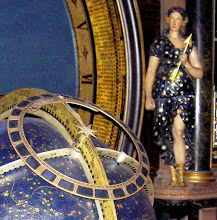
And no it's not named after the old Soviet bloke with the eyebrows ("Thy name is immortal, thy deeds are unknown"), but after the constellation of Leo, where the shower appears to come from. So all you need to do is, find Leo. As luck would have it, Lunchista fille has a map: we bought it at Techniquest, the science exhibition in Cardiff (well worth a visit if you want some entertainment for anyone between the ages of 4 and 12). Here it is.

Leo spends some of its time near the sun, but that's in August so needn't bother us here in November. But it also spends a lot of its time below the horizon, including, when looked at from anywhere in Europe, the entire evening. This means the best time to see it, and the accompanying meteor show, is the wee small hours of the morning. The Planisphere in the shot is set up to show what you can see in the sky at 4 a.m. (GMT) tomorrow morning. Note the flash, which has obscured some of the "sky", is about where the sun would be at this time of year, making our shot even more realistic.

Leo's head looks a bit like a back-to-front question mark, and zooming in to our map shows Leo's head is in the Southeast, about halfway up from the horizon (the edge of the "window") to the zenith (the point where the straight and the curved red lines in the window cross). The dotted white line passes through all the signs of the zodiac and shows how the sun moves around it in a year: each dot is a day. The points of the compass look the wrong way round because you are holding the map over your head.

So the plan here at Chateau Lunchista is for all interested parties to get out of bed ludicrously early and either go up to the attic (from where, the two small Lunchistas assure me, stars can be seen) or failing that, to set out into the playing-field with our jim-jams covered in several extra layers.

It's funny to think that there's always a cloud of meteor debris lurking at this one particular spot that we pass through every November. Given that as we go around the sun, the sun itself is circling the middle of the galaxy, the debris must be following us around. It would always "see" us at the same time of year. Which brings Lunchista to an odd thought: supposing there were an alien spaceship parked about a month further along our orbit. Every time we passed by, we'd be celebrating Christmas. The aliens on board would form the impression that humans in this part of the world spent all the time in over-elaborate, too-brightly-lit places, either eating too much or getting into debt buying things nobody needs.

And of course they'd be completely wrong. Wouldn't they?

Tuesday, 27 October 2009

Postal strike

"My old boss lives round here somewhere...I wonder which is his house?" The street, part of a little knot of recently-built roads which collectively formed a dead-end, was new to me, and to Lunchista fille who had asked to come with me to pick up a package of leaflets from somebody's porch. We kept going round bends that led the wrong way, in roads which all seemed to have been named after Vikings. Well, whatever floats your boat I suppose. There was no-one to ask the way: it was a Tuesday morning and it was easy to see that the place, with its immaculate, open-plan gardens, was completely deserted.

"Listen..."

"What??"

"...nothing. Isn't it quiet?"

And it really was. The older, straight road that led to the one way into the little knot of roads, is itself a dead-end, and as if that wasn't enough we were low enough down to be shielded from the otherwise-ubiquitous noise from our city's ring road. In other words, nobody would break the silence by coming in here unless they were utterly lost, or had some connection to the families in the neat modern houses.

Eventually, right at the far end of the little knot, we located our leaflets under a porch. We noticed wind-chimes hanging there, but even they were silent. I picked up the bundle and we headed back.

It's funny what you notice when things are so quiet: not just sounds, but unusual sights too. Perhaps, like in the American joke about driving down a street looking for the right house-number and turning down the car radio so as not to miss it, we all have a bit of synaesthesia lurking in our brains.

"Hey look at that post-box" There was a banana-skin directly underneath it, but also a note that someone had stuck on near the slot. We went over to see what it said. Someone had posted a letter but forgotten to put a stamp on it: they must have gone back home, fetched a stamp, some cellophane, tape and a pencil and paper, and written the note that we could see, asking whoever collected the letters that day to stick on the missing stamp. As we stepped out into the straight road, we noticed the post-van coming down. We decided to wait and see what the reaction would be, so we carried on walking until he had driven round the corner and had time to stop at the post-box and get out. Then we turned round to kneb.

And he'd gone.

No van, no postie. He must have driven right past all of it. Then I thought, perhaps it's easier for him to turn the van at the end of the knot and then pick up the letters on his way out. So we picked a convenient low front garden wall next to a tree, just within line-of-sight, and we waited. And waited. And, have you ever noticed that, if you have no business waiting somewhere (a bus-stop would have come in handy, or even a dog), it just seems like ages? It's easier with two people than just one because you can always chatter as if you've just bumped into each other or have suddenly developed something urgent and complicated to say (in our case it could have been, for example, the crucial but convoluted logistics of practically any arrangement involving school). We were there for 15 minutes (we timed it).

We could have walked to the end of the knot and back in that time, probably twice, so where was our postie? We gave up and turned to go: we'd just have to put up with never knowing whether the mystery letter would have been delivered.

Then in the few minutes it took us to walk back up the straight road away from the little knot, several other vans drove past us and went in. A florist's. An electrician. Generic tradesman's white vans (several). A red van (not a postie). A fishmonger for heaven's sake: I hadn't seen one of those since I was Lunchista fille's age. All within the space of about five minutes. None re-emerged.

We wondered if someone had maliciously called them all to the same address. Had they all got it in for our postie? Was someone in the knot running a Red Diesel racket? Or had the entire far end of the knot, just after we'd left it with its silent wind-chimes, been devoured by a Black Hole?

Saturday, 24 October 2009

Mean Time


"I'm really looking forward to not having to get up early tomorrow morning!" said Lunchista fille over dinner last night. It's half-term week, so as well as no school, there's no football practice either. Suddenly an entire Saturday morning is open to us to do with as we see fit. Which is just as well, because "350" had decided to declare today a Day Of Action and our city's humble contribution to the worldwide array of stunts many and varied was to form a human chain, complete with Mexican Waves, around the Minster at the eminently civilised time of 11:30 in the morning.

We got there early and immediately bumped into our local eco-enthusiast par excellence (of course) who, knowing that Lunchista is something of a lapsed astrophysicist, mentioned a conversation he and his son had been having about how far it was possible to travel in a lifetime, assuming that you could, over a long enough distance, accelerate to about nine tenths the speed of light. Of course it would be a lot longer than an 80-light-year round trip given that, as your ship accelerates, the time would pass much more slowly for you on board than it would for your stay-at-home relatives, or indeed for any (stationary) aliens you might intend to visit.

The worst bit would be coming home to find everybody you care about passed away or aged beyond recognition. And, assuming Climate Change plays out as currently expected, in our case we'd find our city (presently only some 20 metres above sea-level) about 50 metres under the (all too real and not very Mexican) waves.

I wondered if the son in question had ever listened to the lyrics of '39 by Queen, written by fellow lapsed astrophysicist Brian May. And, walking round to find the event's organisers, I couldn't help wondering also if the Minster, which has been there for the best part of a millennium, would manage to stay around for a second one. At which point I bumped into the organiser of the Nature Reserve, who has been trying to assemble enough of us for a meeting to launch a new "outreach" programme. There are ten of us, and he's had to resort to putting all possible names, dates and times into a spreadsheet in the effort to solve the logistical conundrum involved in assembling us all. How little time everybody seems to have. Even the Year-Long Lunch Break is passing at a disturbingly rapid rate: now more than half gone.

Both mainstream and "skeptics" invoke Time repeatedly in their spiel: skeptics will say either that we still have plenty of it, or else that if you travel back through enough of it you'll see lots and lots of "Climate change" due to volcanoes, the sun, cosmic rays, you name it. And it never killed anyone, did it? On the other hand, listen to anyone serious talking about Climate Change for long enough (in my case about 2 minutes will do) and you rapidly develop a sense of "time running out".

All Lunchista can do is offer you an extra hour tomorrow morning before you have to get up. What can we do with this precious, and some would say illusory, extra time?

Monday, 20 July 2009

Shady rendez-vous

It happened nearly ten years ago, but it's as topical this week as it was then.

What better start for a once-in-a-lifetime expedition like this, than the midnight train? And what better way, given that the end-points of this journey happen to be Glasgow and Basingstoke, to endow the intervening route with a bit of, well, class? Perhaps it's the comforting knowledge that you won't have to stand for all or part of your journey, or that someone will take the trouble to bring you breakfast. Or best of all that, having crossed London, you find yourself, at the height of the rush hour, in commuter trains which are completely empty. It's a bit like stepping into some strange looking-glass version of the UK in which everyone (and you can see them all, crowded onto the opposite platform at each station), works nights.

I wonder if everyone has the equivalent, in their own life, of the friend to whose house I walked from the station. She was one of those characters in whose company events, no matter how well-planned, always managed to take a surreal turn. We'd planned to drive to a guest-house in the west country and get there at some reasonable time, like about eight pm. In the event we got there at about two in the morning, and it had nothing to do with the notorious traffic on the A38 either, and much more to do with the fact that her living-room floor was up, the gas had cut-out and when I arrived she was halfway through laying a patio.

We decided, for the sake of our hosts, to pull up at the far side of the car-park, recline the seats and kip in the car with our coats and some blankets. The following day we thought we'd do a bit of bog-standard sightseeing, but it turned into something of a cream-tea-crawl.

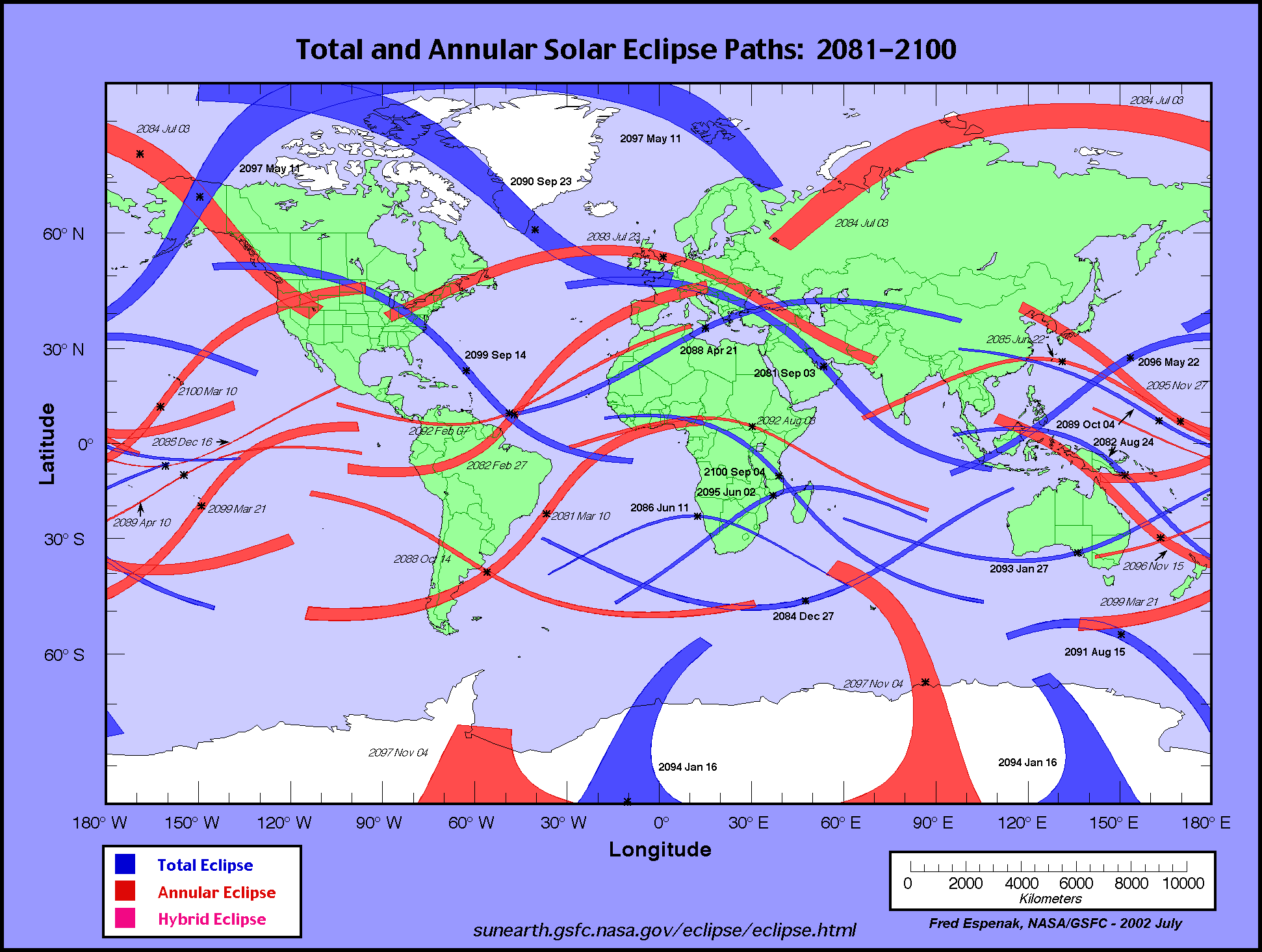
And the day after that was 11th August 1999, and we wanted to get to the beach early and get the best view. We didn't want to miss it and have to wait until 23rd September 2090 for the next one (wonderful to find out that the most detailed timetable you can get, is lovingly compiled by a chap called Fred!) So we were on the road by 4 am. We got flashed at by a speed camera, went round a completely deserted roundabout somewhere near Plymouth twice and then got stopped by the Polis. They shone a torch into the car and, on seeing we were female, middle-aged and sober, let us carry on after asking a couple of questions just for form's sake. I only found out later that our trusty ride had no MOT, and moss growing on the dashboard.

We took our seats on the best promontory by six, had breakfast from a nearby kiosk at seven and were exchanging stories with other "tourists" about how far we'd travelled by eight. Thin, high cloud looked as if it might go away but the weather couldn't quite muster enough warmth to melt it. So we saw the entire eclipse as a play of shadows and sounds.

First the western horizon grew dark, as if a storm was approaching, but without the usual clouds. Then we could see the shadow coming in fast across the sea. As the shade grew deeper I began to notice it seemed to come on in waves from the west, each wave bringing a darker tone. I noticed sea birds were making the kind of sounds I usually associate with evening and the walk back from the beach after a long day building sandcastles. The last few waves brought utter twilight, but with a twist: the shadow isn't large, so the horizon all around us still glowed. Everything appeared lit from underneath. The final wave seemed to bring with it a faint "wuppp!" sound, but I thought I'd imagined it. A minute or so passed with no sound, no wind: no movement. Then waves of paler grey rolled in from the west, and after a short while I found myself thinking of morning walks down to the beaches I'd been to as a child, before I realised why: sea-birds sound different first thing in the morning, and that's what they all believed it to be!

About an hour later I'd started to wonder why I felt so queasy, before I realised I was sitting in the August sun on a Devon beach, still wearing a woollen sweater. You forget about hot summer days after living in Glasgow for three years. From where we were sitting we could walk down to the flat sands and get across, on the "sea tractor" at low tide, to Burgh Island, where the Agatha Christie novel "Evil under the sun" is set.

I found souvenir tee-shirts in Tavistock for the children. it turned out that they'd had a good view of the partial eclipse: the staff of their nursery had thoughtfully loaded everybody into double buggies and wheeled them all out into Kelvingrove Park with their shades. They smiled at the cartoons of the sun and moon on their tee-shirts and announced: "Ut's gooin' tae get darruk a wee but"!

Unlike Lunchista they may very well still be around to see the next eclipse on British soil.

Anyone who's in a bit more of a hurry to see one has until the day after tomorrow to get to, well, almost anywhere in Asia.

Thursday, 28 May 2009

Heart of Darkness


A thought crossed my mind yesterday as I was wading through, and deleting, all the spam that arrives with monotonous regularity in the Lunchista email account. The emails' titles are displayed 20 to a page, and every now and then all 20 are spam! I'd find this astonishing, had I not read in New Scientist ages ago that 90% of all email messages sent, are spam. Yes, 90%!

And so, continuing our astronomical theme for a moment, it occured to me that this is almost exactly the same proportion as the amount, by mass, of Dark Matter in the known universe. Matter which cannot be seen, and whose exact composition is as yet unknown, but without whose additional mass galaxies would spiral to bits, and the universe itself would expand much more rapidly than is, apparently, the case. I have tried to draw it but failed dismally on account of not being able to see it, so an idea of its shape, pinched from the Virgo Consortium at the Max Planck Institut, is shown at the top of this post.

Is it possible that the similarity of these two proportion figures is no coincidence, and that the spam we see is in fact part of some all-pervasive burden of additional mass, and hence work, from which the entire universe suffers? Is it, like the 2.7 Kelvin background radiation discovered at Bell Labs (now sadly demised) in 1965 and initially mistaken for pigeon-muck on their receiver dish, some remnant from the Big Bang that we are dealing with? Could it be that 90% of the original "cosmic egg" was in fact composed of offshore pharmacies, purveyors of dodgy submarine watches and even dodgier university degrees, and promises of physical enhancement unmentionable on a family site, all enlivened by the odd Nigerian warlord's daughter wishing to reclaim her inheritance via your personal bank details?

If this is the case, what is to be done?

Saturday, 25 April 2009

Your chance to test the World's Oldest Weather Radar


Lunchista has just noticed that it's New Moon right now. Rather than attempt to take a decent photo of it, though, I have cheated and availed myself of one from the marvellous Matt's Astronomy Site (thank you Matt).

Exactly two months ago a similar moon picture appeared in our local paper. You can tell a new moon from an old one because it's seen in the evening (not the morning) and (unless you are reading this in Argentina, ZA, NZ, Oz etc) the points of the crescent face left. The paper were puzzled about why the rest of the moon's surface was so well lit-up. It so happened that Lunchista knew the answer, and gave them a call.

The light on the non-crescent part of the moon is known as Earthshine. Whereas the crescent is being lit directly by the sun (but you knew that anyway, didn't you), the rest of the surface, if it is showing, is being bathed in faint light which has been reflected from the earth. Or more precisely, from the part of the earth which can be seen from the moon. Any part of the earth (particularly the 3/4 or so of it which are covered in sea) will reflect more light if it is covered in clouds than if there are none and the dark surface is showing.

Now it so happens that wherever on the planet you are, the new moon is always somewhere to your west. Here in the UK that means it is loitering over the Atlantic Ocean. It is therefore quietly telling you whether or not that ocean is covered in clouds. Just like a weather radar, in fact. The most common type of clouds over the Atlantic are the ones around a Low pressure system. Seen from the moon (or on the weather forecast if you can't afford the fare) it looks a bit like this:


In our part of the world these Lows tend to drift from west to east. That means a Low over the Atlantic will soon be over the UK, bringing clouds, wind and rain. Or at the very least it will be lurking out there ready to throw its rotten weather at anyone rash enough to set sail westwards.

Hence the sailor's warning from Sir Patrick Spens:

"I saw the new moon late yestreen,
Wi' the auld moon in her arms:
And if ye gang to sea, maister,
I fear we'll suffer harm."

Will there be earthshine this evening? If there is, will the dry weather finally break, and give Chateau Lunchista's garden a much-needed drink?