Showing posts with label Moon. Show all posts

Monday, 20 July 2009

Shady rendez-vous

It happened nearly ten years ago, but it's as topical this week as it was then.

What better start for a once-in-a-lifetime expedition like this, than the midnight train? And what better way, given that the end-points of this journey happen to be Glasgow and Basingstoke, to endow the intervening route with a bit of, well, class? Perhaps it's the comforting knowledge that you won't have to stand for all or part of your journey, or that someone will take the trouble to bring you breakfast. Or best of all that, having crossed London, you find yourself, at the height of the rush hour, in commuter trains which are completely empty. It's a bit like stepping into some strange looking-glass version of the UK in which everyone (and you can see them all, crowded onto the opposite platform at each station), works nights.

I wonder if everyone has the equivalent, in their own life, of the friend to whose house I walked from the station. She was one of those characters in whose company events, no matter how well-planned, always managed to take a surreal turn. We'd planned to drive to a guest-house in the west country and get there at some reasonable time, like about eight pm. In the event we got there at about two in the morning, and it had nothing to do with the notorious traffic on the A38 either, and much more to do with the fact that her living-room floor was up, the gas had cut-out and when I arrived she was halfway through laying a patio.

We decided, for the sake of our hosts, to pull up at the far side of the car-park, recline the seats and kip in the car with our coats and some blankets. The following day we thought we'd do a bit of bog-standard sightseeing, but it turned into something of a cream-tea-crawl.

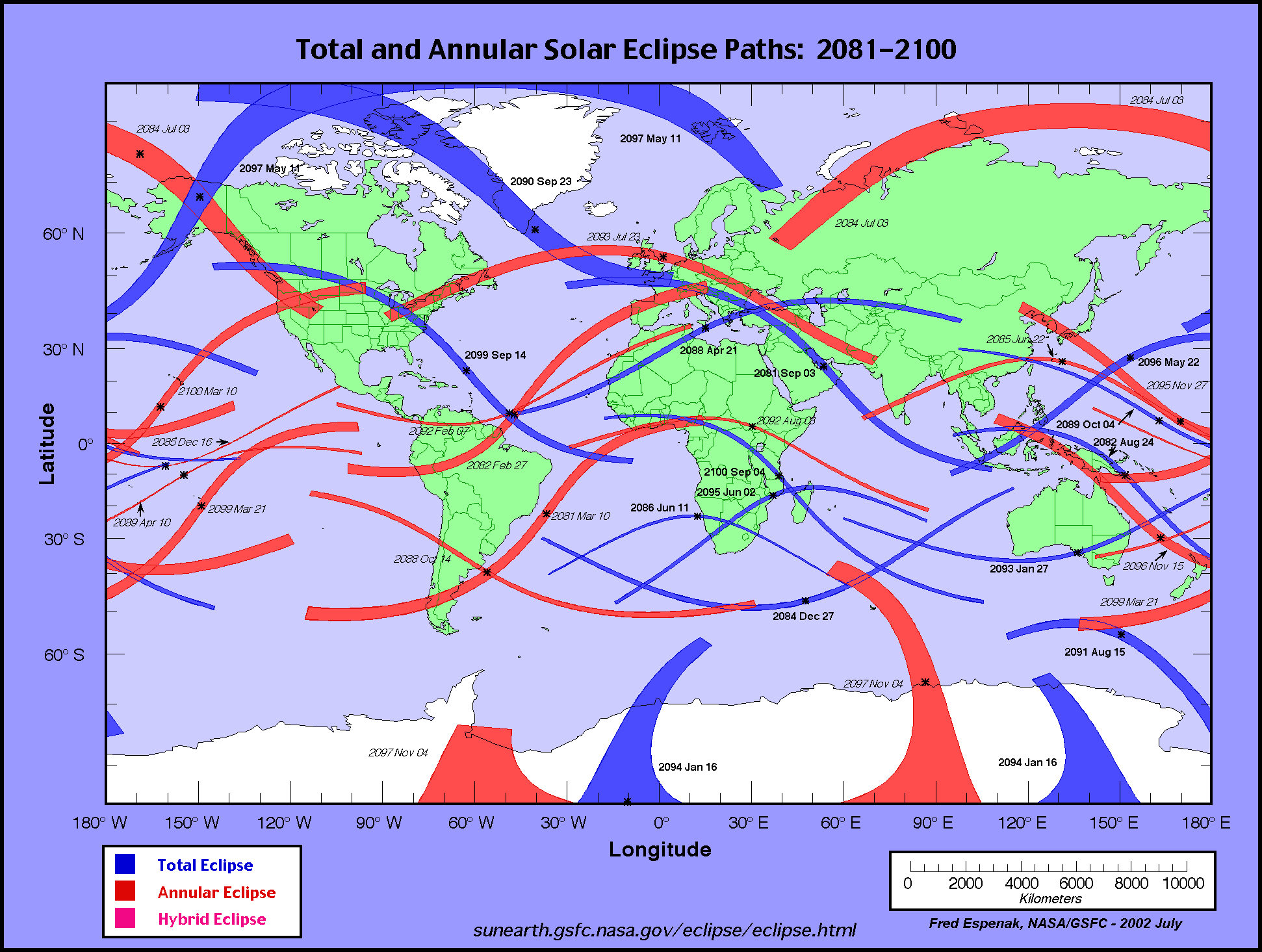
And the day after that was 11th August 1999, and we wanted to get to the beach early and get the best view. We didn't want to miss it and have to wait until 23rd September 2090 for the next one (wonderful to find out that the most detailed timetable you can get, is lovingly compiled by a chap called Fred!) So we were on the road by 4 am. We got flashed at by a speed camera, went round a completely deserted roundabout somewhere near Plymouth twice and then got stopped by the Polis. They shone a torch into the car and, on seeing we were female, middle-aged and sober, let us carry on after asking a couple of questions just for form's sake. I only found out later that our trusty ride had no MOT, and moss growing on the dashboard.

We took our seats on the best promontory by six, had breakfast from a nearby kiosk at seven and were exchanging stories with other "tourists" about how far we'd travelled by eight. Thin, high cloud looked as if it might go away but the weather couldn't quite muster enough warmth to melt it. So we saw the entire eclipse as a play of shadows and sounds.

First the western horizon grew dark, as if a storm was approaching, but without the usual clouds. Then we could see the shadow coming in fast across the sea. As the shade grew deeper I began to notice it seemed to come on in waves from the west, each wave bringing a darker tone. I noticed sea birds were making the kind of sounds I usually associate with evening and the walk back from the beach after a long day building sandcastles. The last few waves brought utter twilight, but with a twist: the shadow isn't large, so the horizon all around us still glowed. Everything appeared lit from underneath. The final wave seemed to bring with it a faint "wuppp!" sound, but I thought I'd imagined it. A minute or so passed with no sound, no wind: no movement. Then waves of paler grey rolled in from the west, and after a short while I found myself thinking of morning walks down to the beaches I'd been to as a child, before I realised why: sea-birds sound different first thing in the morning, and that's what they all believed it to be!

About an hour later I'd started to wonder why I felt so queasy, before I realised I was sitting in the August sun on a Devon beach, still wearing a woollen sweater. You forget about hot summer days after living in Glasgow for three years. From where we were sitting we could walk down to the flat sands and get across, on the "sea tractor" at low tide, to Burgh Island, where the Agatha Christie novel "Evil under the sun" is set.

I found souvenir tee-shirts in Tavistock for the children. it turned out that they'd had a good view of the partial eclipse: the staff of their nursery had thoughtfully loaded everybody into double buggies and wheeled them all out into Kelvingrove Park with their shades. They smiled at the cartoons of the sun and moon on their tee-shirts and announced: "Ut's gooin' tae get darruk a wee but"!

Unlike Lunchista they may very well still be around to see the next eclipse on British soil.

Anyone who's in a bit more of a hurry to see one has until the day after tomorrow to get to, well, almost anywhere in Asia.

Monday, 27 April 2009

Pascal's Wager, meet Moon...


Well, there was an Earthshine last night and this morning It's raining!! It's gorgeous, it even smells gorgeous. I thought about going out and dancing about in it, but then Lunchista is British, and really that would be a bit OTT. Perhaps I'll just have a nice cup of tea instead.

Anyway, it means Lunchista can finally put in all those seeds that have been hanging about waiting for the right time. Which is where the moon (again), and Pascal's Wager, come in.

Now Lunchista has not, historically, been very lucky with seeds. I put them in, I water them, and then I really don't know what happens to most of them, and very probably neither do they. Chances are it is some permutation of: thirst, drowning, birds, mice, cats, slugs, wrong kind of soil, weedkiller courtesy of the Council (it has happened!) wrong phase of the moon, abduction by aliens.

This year, however, we are taking no chances. This year, we have a Strategy.

First, the seeds are going in in the rain. This waters the soil much better than Lunchista ever can. Then, nets will be stretched over them to keep off the birds (and hopefully the mice and cats, and if I'm really lucky one of the aliens will get its foot caught and I shall be famous). Slugs will be hunted down ruthlessly at night-time with a torch and a brick. The soil has been enhanced with compost (lovingly made of old garden detritus and kitchen stuff of the non-meat variety: we have even been known to collect old seaweed). The council are now too skint to stretch to weedkiller. And finally the whole kerfuffle will take place at the correct time: afternoon, as near as possible to new moon. You are doubtless now entertaining the possibility that Lunchista has finally lost it. However...

There exists a school of thought known as Biodynamics. It has a noble, and very interesting, pedigree, including all sorts of characters ranging from Mr Steiner (of Steiner School fame) to the Soil Association. Lunchista is a fan of the Soil Association and in fact everything in the garden here that has already started to grow, seems to do very well by it. So let's put the moon-phase bit to the test, Pascal's-Wager-style, because we have nothing to lose.

Pascal's Wager applies to those kind of risks for which you have no idea of the odds, but you'd like a favourable outcome. Picture, if you will, a slice of Battenburg cake:


Thank you, ForTheLoveOfBritishFood (who also have the recipe), don't mind if I do.

Imagine the four squares represent a set of the four possible outcomes. Taking these in order row-by-row:
1. You take precautions, it turns out you were right to do so. Yellow smiley square.
2. You didn't take precautions, but you should have done. Pink girlie disaster!
3. You took precautions but you didn't need to. Pink embarrassment or perhaps wasted time or cash.
4. You didn't take precautions, it turns out you didn't need to. Yellow smiley square again.

Now what most people do is compare the two pink squares, then make their choice about precautions. It turns out this is an easy decision in the Biodynamics case because if Mr Steiner turned out to have been right, and Lunchista ignored him, we get pink disaster (no seeds come up). However if we follow his idea and it turns out that the moon phase is an irrelevance we end up with square no. 3, but no time or cash has been wasted and really, do you think Lunchista cares all that much about embarrassment? So, pink square no. 3 it is, please.

Pascal's Wager has been used as an argument in favour of religious practice: you may not know whether or not God exists but you may as well sing along with the choir because spending a bit of time on Sundays (pink square no. 3) is better than spending eternity on the cosmic bonfire (pink square no. 2).

But there's a twist in the tale. Going back to Mr Steiner, supposing that he got it wrong, not in the sense that it turned out that the moon phase didn't matter, but in the sense that the phase mattered but was the opposite of what he said??

Multi-dimensional Battenburg slice, anyone?

Saturday, 25 April 2009

Your chance to test the World's Oldest Weather Radar


Lunchista has just noticed that it's New Moon right now. Rather than attempt to take a decent photo of it, though, I have cheated and availed myself of one from the marvellous Matt's Astronomy Site (thank you Matt).

Exactly two months ago a similar moon picture appeared in our local paper. You can tell a new moon from an old one because it's seen in the evening (not the morning) and (unless you are reading this in Argentina, ZA, NZ, Oz etc) the points of the crescent face left. The paper were puzzled about why the rest of the moon's surface was so well lit-up. It so happened that Lunchista knew the answer, and gave them a call.

The light on the non-crescent part of the moon is known as Earthshine. Whereas the crescent is being lit directly by the sun (but you knew that anyway, didn't you), the rest of the surface, if it is showing, is being bathed in faint light which has been reflected from the earth. Or more precisely, from the part of the earth which can be seen from the moon. Any part of the earth (particularly the 3/4 or so of it which are covered in sea) will reflect more light if it is covered in clouds than if there are none and the dark surface is showing.

Now it so happens that wherever on the planet you are, the new moon is always somewhere to your west. Here in the UK that means it is loitering over the Atlantic Ocean. It is therefore quietly telling you whether or not that ocean is covered in clouds. Just like a weather radar, in fact. The most common type of clouds over the Atlantic are the ones around a Low pressure system. Seen from the moon (or on the weather forecast if you can't afford the fare) it looks a bit like this:


In our part of the world these Lows tend to drift from west to east. That means a Low over the Atlantic will soon be over the UK, bringing clouds, wind and rain. Or at the very least it will be lurking out there ready to throw its rotten weather at anyone rash enough to set sail westwards.

Hence the sailor's warning from Sir Patrick Spens:

"I saw the new moon late yestreen,
Wi' the auld moon in her arms:
And if ye gang to sea, maister,
I fear we'll suffer harm."

Will there be earthshine this evening? If there is, will the dry weather finally break, and give Chateau Lunchista's garden a much-needed drink?