Thursday, 28 May 2009

Heart of Darkness


A thought crossed my mind yesterday as I was wading through, and deleting, all the spam that arrives with monotonous regularity in the Lunchista email account. The emails' titles are displayed 20 to a page, and every now and then all 20 are spam! I'd find this astonishing, had I not read in New Scientist ages ago that 90% of all email messages sent, are spam. Yes, 90%!

And so, continuing our astronomical theme for a moment, it occured to me that this is almost exactly the same proportion as the amount, by mass, of Dark Matter in the known universe. Matter which cannot be seen, and whose exact composition is as yet unknown, but without whose additional mass galaxies would spiral to bits, and the universe itself would expand much more rapidly than is, apparently, the case. I have tried to draw it but failed dismally on account of not being able to see it, so an idea of its shape, pinched from the Virgo Consortium at the Max Planck Institut, is shown at the top of this post.

Is it possible that the similarity of these two proportion figures is no coincidence, and that the spam we see is in fact part of some all-pervasive burden of additional mass, and hence work, from which the entire universe suffers? Is it, like the 2.7 Kelvin background radiation discovered at Bell Labs (now sadly demised) in 1965 and initially mistaken for pigeon-muck on their receiver dish, some remnant from the Big Bang that we are dealing with? Could it be that 90% of the original "cosmic egg" was in fact composed of offshore pharmacies, purveyors of dodgy submarine watches and even dodgier university degrees, and promises of physical enhancement unmentionable on a family site, all enlivened by the odd Nigerian warlord's daughter wishing to reclaim her inheritance via your personal bank details?

If this is the case, what is to be done?

Wednesday, 27 May 2009

Inter-Planetary Lunchbreak

You could say last Sunday was a family day out with a difference: Famille Lunchista got nearly as far as the planet Saturn, using only bicycles for transport and Lunch for fuel.

About ten years ago some Astronomical wit from our local Uni teamed up with the nearest School, and Sustrans (the people who convert old railway track sites into nice flat, car-free cyclepaths), to create a 10km-long scale model of the Solar System extending along one of said paths to the South of the city.

There is an 8-foot diameter Sun near the chocolate factory (now sadly demised: what is our country going to do for future supplies of fuel?), accompanied by minor planets on their own plinths with useful information such as how far you have travelled. Using the "actual size" scale, walking pace is about three times the speed of light, and cycling is about ten times. The more relativistically-minded may thus work out how many years younger you can become by walking or riding along the route and, given that faster-than-light travel means that you finish before you started, profit from the fact that you can actually get that report written by yesterday, and still have time for lunch.

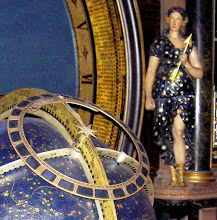
There is an organic nursery round about where the Asteroid Belt should be, and somewhere between Jupiter and Saturn (near the Cassini Probe in the picture, in fact) live a Polish family who run a cafe during the summer (that's terrestrial, Northern Hemisphere, to avoid confusion). You can stop off for a nice cup of tea that's almost big enough to float one of the Gas Giants in (yes they'd float: they are less dense than water).

In the past we have been known to go all the way to Pluto and back, but this time we turned off just before Saturn, to get a look at a local wood famous for its bluebells and slightly surreal sculptures. We sat and had a picnic lunch next to a wooden dragon, who didn't seem to mind.

And by how much did all this entertainment set back the travel budget of Famille Lunchista? The coolest amount known: Absolute Zero!

Thursday, 21 May 2009

The Eco-Slob School of Design


The afternoon sun is glinting on freshly-fallen rain, Lunchista had a particularly successful slug-blitz a few nights ago (and none have been spotted since), and it's the last sliver before new moon. Perfect. So what better time to share with you Lunchista's delight on discovering that an awful lot of this seed-planting lark, together with the ensuing angst about whether they'll come up (and why they don't), is completely and utterly unnecessary?

Welcome to the wonderful world of Permaculture ("Permanent Agriculture"), a way of designing landscapes of all sizes (and by extension, anything else) in such a way that Nature does most of the work so you don't have to! I stumbled across the term quite some time ago, but it has to be said that since then the parts of Chateau Lunchista's garden given over to it are doing rather well.

Now Permaculture does assume that you have quite a lot of time on your hands, at least initially, because you are asked to walk around (or sit and watch) your landscape and notice what's going on. Where do some areas naturally start and finish (e.g. dry parts, shady parts, parts frequented by any local wildlife...), and within each of these, what kind of plant (or weed, if you haven't planted anything yet) does well, and what struggles, gives up the ghost or is completely absent?

It almost sounds like cheating, but really it's best to plant the kind of thing you know is going to do well, and forego the kind of plant that's going to struggle. We started off with herbs, planting them near the door so there are the nice scents as you come out, oh and so you don't have to pick your way across a soggy lawn in the rain just to get some thyme for the spag bol. Those nice scents scare off various pests, so you can borrow herb plants and put them next to things that would otherwise suffer: all the little roses in our garden have chives as companions, to keep off the greenfly. There are a lot of "things that grow like weeds" which are actually useful: mint, strawbs, hazel, lemon-balm...

There are tactics such as thinking "upwards" if there's not much room in your landscape, or mimicking the seven height layers of a forest (Canopy, trees, shrubs, herbacious, ground-cover, roots, and climbers as shown in the illustration nicked from Spiralseeds: thanks guys!) if there is. So the Lunchista garden now has trees and shrubs. For the dosh-conscious, I might add that the phrase "mature garden" looks good on estate-agents' blurb.

The real hard-core like to take things which would otherwise be rubbish and turn them into something useful: they earth-up spuds in neat towers of abandoned tyres, make paths out of old bricks and assemble cold-frames out of disused windows. The softer option is to just make sure all the waste that a garden makes goes back in as something useful: we have a compost dalek, out of which something vaguely approximating soil comes every spring and autumn. The ash from the woodburner can also be spread about as fertiliser, but apparently coal-ash is a no-no because of heavy metal which can harm your plants. Something called "Jack-by-the-hedge" has seeded itself in our garden, and I'm just letting it carry on because it's edible and, as the name implies, will grow next to hedges: a place where everything else struggles.

Getting back to the seed question, why bother digging up expired annuals and replanting every year, when you could find something perennial which would give you almost as much yield? Recently that very question turned up in a rather thought-provoking BBC programme about the future of farming. One of the interesting factoids that transpired was that you could get almost as good a yield (calories and protein per acre, for example) from nut trees with assorted things growing around them as you can with grain. And none of that messing about with ploughing, spray-on weed-killer, fertiliser and the like. Alternatively you can be like Bruce the "lazy Aussie Farmer" and make more cash, even with less yield, by simply not bothering with a lot of the "input costs".

But Permaculture fans don't want to limit their design principles to gardens and farming: there's also housing, transport, healthcare, learning... And there isn't necessarily a size limit to the area involved, as long as you adapt optimally to each different part, letting nature do as much of the work as possible. So you could, in theory, have a village, with all its surrounding farmland, designed "permaculturally". Or a county, even a whole country.

Wednesday, 20 May 2009

Leafletised!

How did all that lot get there? Well, in the run-up to an election (and a possible 'flu pandemic) these particular individuals were delivered by Royal Mail as part of a Freepost agreement, but quite a lot of other agitprop arrives at Chateau Lunchista by the hands of total amateurs, who deliver it as volunteers.

In our city the Council can provide you, if you ring up and ask, with special stickers with a recycling logo on and the legend "No Junk Mail Please: Reduce, Re-use, Recycle" or somesuch, to stick on your letter-box and ward off the worst offenders, such as plastic envelopes containing CDs with information about expensive hearing aids (it has happened).

Let's just say that in complete contrast, the type of missive delivered by Lunchista (newsletters from our Councillors, information about recycling, Warm Front and the like) is rather more public-spirited, occasionally even useful, and at the very least anyone who doesn't like it it can lob it on the compost, in the recycling or on the woodburner.

If you want a nice quiet morning or afternoon getting to know your immediate neigbourhood while clocking up a spot of excercise, then "leafletising" (as one of the smaller Lunchistas calls it) takes some beating. It's far cheaper than getting a dog, and there's no muck to clean up afterwards. It is also a totally shameless excuse for a quick kneb at people's gardens.

It's a slightly strange sensation walking around in the middle of a weekday: I'm used to there being far more people about. Apparently of the 60 million Brits, only about 30 million actually work in a job. Knock off an additional 10 million or so who are at school, and there should still be a good third of the population around somewhere. It's a fine day (difficult to deliver leaflets if it's raining: they get soggy and won't go through the brushes in people's letter-boxes), there are front gardens, the nearby shops are open, it's peacetime, so where is everybody?

I wonder, is sitting in your front garden reading or watching the world go by, something of a lost art? Because the only person I have ever seen doing this in a street near us, was at least a generation older than me. Every morning at 7 am (yes, really!) he would walk out of the old folks' home on the corner with his cushion and sit on the wall: well, perch on it really, because a high hedge overgrew the wall, meaning that no-one from the old folks' home could watch the world go by from the comfort of their lawn. I always used to say hello. You wonder what people did in their past: perhaps he once took part in a daring escape from a PoW camp. Perhaps he was a spy (or perhaps he still is).

So, here's Lunchista, bag over shoulder, setting off for the usual round of about 300 houses. There's a certain ettiquette: after all you are the ambassador for whatever it is that the leaflets are promoting. Gates have to be opened and closed (not climbed over); walls between neigbouring gardens should be walked around, not jumped over; dogs should be talked to, even the ones that scare you witless. And above all, because so few people are in, the leaflets should completely disappear into people's doors, instead of poking out all day saying "hey Mr Burglar, nobody's home here!". This happened once at Chateau Lunchista: I was near the door at the time, so the baseball-cap who'd delivered the leaflet got an impromptu lecture about crime prevention. It was only fair: the leaflet in question was, of course, about Crime Prevention.

Monday, 18 May 2009

Your turn!

Picture the scene: Burns' Night (that's 25th January if you're not in the know about such things), massive "supper", the type that kicks off with the dramatic entrance of The Haggis, complete with bagpipes and ode praising its life-sustaining qualities, followed by its distribution to all present, and by some of us at least eating rather a lot of it. Just before you start to scream, might I add that there is such a thing as a vegetarian Haggis, they're delicious, and somebody had thoughtfully made sure that they were available on this particular night.

Now Burns' Night tends to follow a certain loosely-agreed "order of battle" which, after the main speeches about Poetry, Life, the Universe and Everything, the "Toast to the Lasses" and the ever-witty "Lasses' Riposte", can involve the rest of the evening's entertainment being put in the hands of the guests. Lunchista had a bit of a reputation for banter among this particular crowd, which was cheerfully invoked by the MC before I was invited to come up and get the evening's show off to a good start. No prior warning. For about a hundred people. Including the family.

Well what would you do, if this happened to you?

It wasn't until days later (it turned out to be an extremely good evening!) that it crossed my mind that the things that people have learned off by heart are in a way a resource, just like food or fuel. If you have them, you can provide for other people. A lot of us haven't bothered with this for centuries though, first because we could always look up poems in books, and later because we had the choice of switching music on, rather than having to go through all the hassle of playing it ourselves. It is also sadly true that commiting things like poems to memory, or learning to play musical instruments, both take up rather a lot of time: time which is in short supply when we are all frantically alternating between earning as much money as we can, and spending it in such a way as to impress the largest possible number of people.

But occasionally large amounts of sort-of-spare time get dumped on us without warning, for instance if we are lain off work, or go off the edge of the piste and break something. Many moons ago Lunchista got involved in Gilbert and Sullivan operettas(!) and it turned out that the chap who, for five years running, sang all the classic "patter" numbers (like "The Nightmare Song" and "Modern Major-General") only had to brush up lightly on his words, because he had used his time on an isolation ward during a Malaria scare several years previously to practise them to the point of perfection.

Even if you're not unlucky enough to be suspected of harbouring malaria, you might still be unlucky enough to have to commute, in which case some of the time might be salvageable for memorising poetry or sketches. The 60-minute train journey of my London to Brighton commute, it turns out, was used by some enterprising soul a few years after I left as a venue for her French conversation class.

Meanwhile the smaller Lunchistas, after all this, have been inspired to memorise a couple of items of choice: one of them can now sing all of The Galaxy Song, and the other is working on an anthology of terrible puns: perhaps this runs in the family!

Before I finish I might point out that here in the British Isles, it's us English who are the real slackers in the spontaneous home-made entertainment department. In Ireland, so I'm reliably informed, it's not unusual to come across an evening in a pub where all the "turns" are done by just anybody who feels like joining in. Scotland, as already mentioned, has Burns' Night and various other occasions, and I might add that my Burns' Night experience as described here took place in Wales. Yes, Wales, home of the Eisteddfod, and possibly even of Rugby songs.

Anyway, in the time it took me to get to the front of that room I remembered that there was a poem I had learned by heart decades ago, because it was funny and I happened to like it. So Silly Old Baboon (thank you Spike Milligan) kicked off the evening's entertainment, raising quite a few laughs into the bargain.

Wednesday, 13 May 2009

How to afford a year-long lunch break: 2


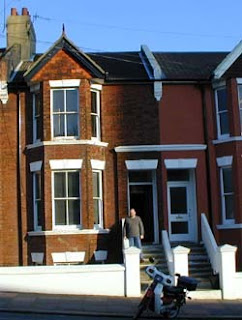
Perhaps I should have called this post "Dives I Have Known", because it's really a matter of cheap rented gaffs, how I found them, and how I got by living in them. One of my luckier finds was very much like this house (thank you Ned Hoskins of Artists' Open Houses) although it was not, sadly, full of artists.

On landing a new job, which is of course many miles away from your previous job, a Brit has 2 choices: stay where you are and commute, or up sticks and move. There is also the ghastly third choice of weekend commuting, but Lunchista has tried this and found that short of actually dying it's the quickest way ever to lose touch with your friends and, indeed, most of your life. I have also watched other people do it and end up divorced, or worse still stuck in a jam on the M25 at 4:30 on a Monday morning.

Of those three choices, by far the best for an unattached, and un-roadworthy, Lunchista was to move. In the days before Google Earth, and assuming the place is so new to you that you don't yet know anybody who lives there, the first step was to go to the new city, get an AtoZ and a local paper at the station, take a taxi to somewhere vaguely near the workplace (not forgetting to chat to the taxi driver for interesting local information), find a seat, get out a pen, then find a phone-box and start calling (and walking). If it was raining I just got wet. The important thing is to avoid agencies, because these people are paid extra to get you into somewhere expensive, and waste a lot of time talking about places which are totally unsuitable. "It's a beautiful village" "I'm sure it is, but it's 15 miles from where I want to live, and I don't drive...".

The list of priorities was as follows:

1. If I can't walk there, forget it
2. Cheapness
3. Brightness
4. Hot water
5. Non-immaculate decor

And that was it. The hot water needn't mean heating, it's surprising how quickly you get used to life without it. The non-immaculate decor might need some explanation. It so happened that while I was still a student, I noticed a definite correlation between a Landlord (or Landlady)'s laid-back attitude to appearences, and a happy crowd of tenants. Also, decor is only superficial and anything that was too rough even for Lunchista could easily be sorted ("Do you mind if I paint that wall? It looks a bit sad..."). I also developed a preference for older, terraced houses.

Let's just say that the places I found using this algorithm were not for the faint-hearted. There was the landlord whose brother was rumoured to be a gun-runner for the Contras in Nicaragua. The council found out that we had no fire escape so we all had to move out that week. My protestations that I lived in the basement flat, and anyway it was far too damp to ever catch fire, fell on deaf ears. There was the attic flat that was my utter favourite, until the ceiling fell in one night (while I was away. Why was I elsewhere? Because two nights previously I'd had this terrible nightmare about the ceiling falling in...)

Some people made a lot of noise: the couple who argued on the stairs at 2 am when I had to get up at 5 were the worst. But music-type noise could be dealt with: here is my method, and it really does work.

Walk into the room where the music is being played, ostensibly to borrow, return, ask, something unrelated to the music. Just take in the atmosphere. Notice where people are sitting and what they're doing. Ask anything (except, at least initially, if they're into Heavy Metal), just generally chat for a while, then make your excuses and slope off. Next time whoever it is is playing music, you have a ready-made mental image of what they're doing. It's nothing drastic, or scary, or unknown. The music's just music, the back of your brain no longer regards it as a threat and you can get on with your Physics, reading, or sleeping.

Things would sometimes go wrong, though, at my "end of the Market". There was one Landlord who went bankrupt, left the country and then the whole street came up for sale. Another had a nervous breakdown (nothing to do with me, honest...). One of my Chinese friends had an elderly landlord whom he used to look after a bit. One morning he brought this old chap his usual morning tea and found he'd passed away in the night.

But cheap rented gaffs had their consolations. Chief of these was the concept of the shared kitchen. Because with the shared kitchen came new friends, local information and new dishes to try: in those days everyone had at least one dish they could cook, so the more people you shared with, the more you learned. I consider myself lucky to have done all my kitchen-sharing before the hegemony of the dreaded Microwave.

Here was my contribution to the fray: classic student-style Spag-Bol (feeds four at one sitting, or one student each night of the working week). Gently fry 2 chopped onions and 2 finely-chopped cloves of garlic, then tip in 1 pound of mince and fry til it has changed colour (it doesn't have to be completely done yet). Meanwhile in a separate pan, put in 2 tins of the ever-useful Italian tomatoes, some sticks of celery (finely-chopped), a few mushrooms (ditto), herbs like thyme and a bayleaf if available, and a spoonful of Bovril or Marmite. Lift the meat and onions out of their liquid and add to the tomato mixture. Heat these up until just shy of boiling, then turn down and simmer for at least 1/2 an hour. For added panache, pour in any wine that nobody wants to drink (anything up to a large glassful, and check first that no-one has dropped anything in it). For the pasta I have found that about 75g as measured when dry, per person works.

Of course another consolation of cheap rented gaffs was their sheer cheapness, which enabled the saving of money towards a project of choice (going on a course, visiting China, waiting for a recession so you could buy a house, or even being able to follow your favourite footie-team...) The people of the 1980s always said "rent is Dead Money", but if it didn't amount to much, did that really matter? And anyway, can someone remind me what exactly the first four letters of the word "Mortgage" mean?

Tuesday, 12 May 2009

In praise of Older Stuff


Here is a younger member of famille Lunchista who knows a good bureau (and a perfectly-dimensioned little place in which to pretend to have a kip) when she sees one. In fact a lot of our furniture, though not as venerable as this piece, are cast-offs, or heirlooms, depending on your point of view, from other parts of famille Lunchista and beyond. The desk at which Lunchista is typing these musings was a cast-off from our former next-door neigbours when they were re-arranging their older son's room. The chair on which I am sitting and (until it died on me, about 5 years after its expected lifespan I grant you) the computer on which I wrote, were cast-offs from the local University, who have periodic refurbishments to keep up with the expectations of today's high-maintenance students (though to be fair, yesterday's low-maintenance students had grants and didn't have to pay tuition fees).

We are not so much "people who buy their own furniture" (as Alan Clark once famously sneered about Michael Heseltine) as people who cadge it, or pick it up secondhand for a song and then choose a fine day to wheel it out into the yard, scrub it down and restore it to its former glory (or indeed to something else altogether).

Why do we do this? Well, because it makes for cheaper, higher-quality, more interesting furniture. Let me explain:

The "cheaper" part is kind of obvious. Unless you're going for a genuine Chippendale (I mean the furniture not the gentlemen in ties and cuffs), or a Ming dynasty vase or the like, older stuff simply costs less. The "higher-quality" bit needs a bit more explanation: bear with me while I conjure up an image of a bath-tub.
Thank you, Charlene Winter Olson, I hope you don't mind if I borrow it.

Imagine a tape-measure placed along the floor from left to right under the bath, with time on it, in years, instead of length in cm. The probability that anything you buy, from a car to a table, will develop a fault or give up on you in a particular year, follows a shape just like the profile of the height of that bathtub as you (or your pet spider: every bathroom has one) move along the tape measure underneath it. The flat bottom of the bath stretches along all the years when your purchase does well: your table is stable or your car doesn't break down. The gentle upward slope on the right represents more and more faults happening as your purchase gets really old and knackered.

But what everybody forgets, is that steep slope on the left. Brand new stuff is more vulnerable to everything from catastrophic design faults to bad manufacture, including something as simple as the shine wearing off. Older stuff has begun to "stand the test of time": if it's still shiny (for example), or sturdy, it is far more likely to remain so. The "Bathtub Reliability Curve" is a well-known story in engineering circles.

Add to that the unsavoury practice of built-in obsolescence that's been popular since the 1960s and you can see why older stuff is a better bet: it was simply built to last. Lunchista happens also to think that a lot of it even looks more stylish. But there's more.

Old stuff gives a place an extra dimension: the dimension of time.

Some people seem to go out of their way to avoid this, but you have to wonder, why? In China, where I've seen for myself that people generally have a massive preference for the new over the old, it's understandable. In a lot of cases the past would have been very painful (how does partial occupation, two wars and two famines in living memory sound?), and something about which people would probably rather not be reminded by their present everyday stuff. But here in the UK?

Sometimes if I walk into a place and everything's new, my first thought is: how very, erm, temporary. Where were these people 18 months ago? Is there something in their past that they'd rather forget, or even hide? If it's a business, will they just disappear? This actually happened once, after I really had thought that of a new workplace. We ended up with 90 minutes to clear our desks!

It all goes to show, without time, really, we are nothing.